HKpowerStudio

Creatively Organized Spaces

  • HOME
    • POLICIES
  • ABOUT
    • TEXTILE BACKGROUND
  • SERVICES
    • PROFESSIONAL ORGANIZING SERVICES
      • CLOSET DESIGN
    • ART ADVISING & APPRAISAL
    • VIRTUAL SERVICES
      • HOME INVENTORY
  • BLOG
  • RESOURCES
    • SCAD Alumni Mentor Presentation-2026
  • MEDIA
  • CONTACT

A Craft Lens Approach

October 8, 2026 by Heather Filed Under: Appraisal, Art & Design, Collections, Creative process, Estate Planning Leave a Comment

Over the last several years, I’ve shifted my focus from just organizing things to understanding their significance and value, historically and personally. This isn’t how every organizer works, but I hope more people think about it. A large portion of the US and Global population have amassed a HUGE amount of STUFF. Much of it will be shifting hands in the coming years. This has me wondering what will happen to it all.

What is a CRAFT Lens?

It’s not fancy eyewear or special camera gear. If you look it up, that’s probably what you will find. It is a framework with no single definition. Here’s how I apply a craft lens.

What's A Craft Lens?I am a designer and craft thinker, maker, and researcher. I learned this early in my career as a designer of handmade textiles. I could design a gorgeous concept, but if I didn’t interact with and get feedback from the craftspeople and technicians making it, it wouldn’t succeed. The same applies to organizing solutions. I can research historical documents/solutions for inspiration, but they have to work with present-day materials and makers. Slowing down and noticing what goes into things, looking closely to understand the interconnectedness of objects and makers, is foundational. It’s still how I approach every project.

My skills and knowledge are only part of what informs my process. I usually set my initial concept aside to look for other relevant information. My ideas shift to account for new input. The creative part of my process is integrating it all!

I think less about individual solutions and more about the larger systems that uphold old, broken, and outdated ideas. I seek to repair what is broken, care for what’s been forgotten, and find solutions that are better for everyone. Very optimistic, I know. I don’t always succeed. Craftsperson and activist Betsey Greer coined the term ‘craftivism’ and defines it as ‘a way of looking at life where voicing opinions through creativity makes your voice stronger, your compassion deeper’.

How does a craft lens apply to my work?

  • Question-based research; learn to ask better Qs
  • Object studies; slow & fast seeing, thinking & making
  • Bringing the invisible into focus; looking for untold, under-appreciated or undocumented histories
  • Drawing upon a range of research methodologies such as oral history, anthropology, & ethnographic studies
  • Thinking, talking & writing about craft practices, methods, theory & history
  • Being aware of extractive transactions; looking for partners who are not only interested in making money, but in telling stories & preserving histories
  • Framework of living craft: our homes, gardens, food, & community-building all demonstrate craft
  • Reciprocal teaching: we are all teachers & students

Craft is tradition; whose traditions do we uphold?

To understand traditions we have to zoom out to our families, communities, cultures. Traditions can be defined within each of these social contexts. In 2003, the UNESCO Intangible Cultural Heritage defined Traditional Craftsmanship as follows in terms of makers, not just objects;

“Rather than focusing on preserving craft objects, safeguarding attempts should instead concentrate on encouraging artisans to continue to produce craft and to pass their skills and knowledge onto others, particularly within their own communities.

There are numerous expressions of traditional craftsmanship: tools; clothing and jewellery; costumes and props for festivals and performing arts; storage containers, objects used for storage, transport and shelter; decorative art and ritual objects; musical instruments and household utensils, and toys, both for amusement and education. Many of these objects are only intended to be used for a short time, such as those created for festival rites, while others may become heirloom that are passed from generation to generation. The skills involved in creating craft objects are as varied as the items themselves and range from delicate, detailed work such as producing paper votives to robust, rugged tasks like creating a sturdy basket or thick blanket.

Like other forms of intangible cultural heritage, globalization poses significant challenges to the survival of traditional forms of craftsmanship.”

I keep this definition present when considering preserving craft. I’m curious to find solutions to preserve traditions (not just objects). Does an object have the ability to teach someone something about making in the future? Is it historically, culturally or materialistically doing work to provide a better understanding of skills or living with objects? This is a cyclical process of conversing, reviewing, and refining. As a form of social engagement this invites others in, rather than being exclusive. It provides a framework to situate objects within culture, and the stories of the individuals that make them.

Which stuff should be saved and why?

I once heard a historian say that our collective history lives in the attics and basements of the average person’s home. NOT in museums. What will happen when we shift all this stuff from one generation to another? Will our history end up in landfills? Are the stories behind objects important to future generations? If not, why not? I have some theories about this. This is where the Craft Lens comes into my work.

I apply craft lens as framework to my work as an organizer, advisor and appraiser. I feel inclined to share stories behind objects and makers to help others understand how I integrate design, craft and organizing, to advising, and appraisal. This feels like the only way I can do this: by bringing all of myself into all my work.

Practice makes progress

January 10, 2026 by Heather Filed Under: Creative process, Planning & Goals 2 Comments

I’ve been reflecting on my word for 2025, Courage. Courage is a value, and living our values takes practice.

Practice has been on my mind for about a month now. Ever since a young lady (11 years old) shouted out, Practice makes Progress, during a community discussion about a creative film I’d just seen. I felt so encouraged and inspired to learn that this is the message she had learned from one of her teachers. Out with the adage that practice makes perfect, because we all know that is just not true!

So, as I danced with discovering my word for 2026, practice was at the top of my list of possibilities. In past years, I’ve explored quite a few methods for finding my word of the year (WOTY). This year, after over a decade of this practice, it’s become more intuitive. That is a perfectly cyclical example of practice making progress.


Collage text spelling PracticeAs I do when I am considering words that I want to focus my intentions and attention on, I look at how they are connected to other words. So I explored the visual thesaurus (below) and kept digging. Yes, some of these words are synonyms, some reflect aspects of practice and I’m sure I’ll dance around with all of them over the coming year.

Practice word cloud

More than any of the anything above, I realized that giving myself permission to practice means exploring failure, doing things imperfectly and allowing whatever will be to come to the surface. In this, I realized that ALLOW was also a word I wanted to explore this year. Carrying over from my exploration of courage, which sometimes felt heavy, as if I was lifting or pushing things, I am opening myself to something softer in practicing and allowing.

Finally, one additional word came to me as a gift. Generosity landed with me through a spontaneous and intuitive process of writing down words (values/intentions) and releasing them until only one remained. Generosity remained.

And so, this year I find myself working with a word sandwich, or salad of three: PRACTICE, ALLOW, GENEROSITY. I am excited to discover what I will learn about myself and the world around me through an exploration and application of these three words in 2026. Each word remains a part of me when I choose them. I explore them with curiosity, deep intentionality and intensity.

My previous words over the past DECADE of selecting a WOTY.

  • 2011: CLARITY
  • 2012: SOAR
  • 2013: RADIANT
  • 2014: PLAY
  • 2015: CHOICE
  • 2016: HARMONY
  • 2017: ACCEPTANCE
  • 2018: FEARLESS
  • 2019: INTENTION
  • 2020: INTEGRATION
  • 2021: POSSIBILITY
  • 2022: HOPE
  • 2023: DELIGHT
  • 2024: COMPASSION
  • 2025: COURAGE

I would love your thoughts on the Word of the Year (WOTY) process. Please comment on this post to let me know your word (s).

The Benefits of Personality Testing

July 23, 2025 by Heather Filed Under: Creative process, Health, Inspiration & Education, Organize, Planning & Goals, Productivity, Tips & Resources, Wellness & Mindset 1 Comment

We are all born unique and with different personalities. Are you curious to know more about your personality and how it can affect your day-to-day life? If so, the benefits of Personality testing include giving insight into how we think, handle stress, how we process information and make decisions.

Personality tests are very popular, with many employers requesting a candidate take a personality assessment during the job application process. If you were to Google ‘Personality Test’ you would be flooded with many claiming to be the best. I will showcase a few here that I believe are the most accurate and helpful when we want to learn more about ourselves.  No personality test is the same, just as no person is the same.

Myers Briggs

The most popular and well-known Personality Test is Myers Briggs. It gives you insight into many different personality traits and identifies the 16 most distinctive personality types. It is a 15-20 minute assessment that asks you about the way that you Benefits of Personality Testingthink, how you process information, how you make decisions, how extroverted (or introverted) you are, and how you perceive information.

Once you have taken the assessment and receive your result you will also be given information on your personality type and how understandings your type can benefit you in your daily life. You can further research your personality type to help you connect you with like-minded individuals or understand those with strikingly different personalities.

Enneagram

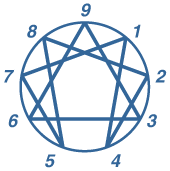
You may have heard people toss around their enneagram ‘type’ as a number, similar to how people talk about their MB above as a series of letters. The test for your enneagram personality type is

The Enneagram

done by a simple multiple choice quiz (which some might describe as pseudoscientific), which takes about 10 minutes.

There are nine types of enneagram personalities. Like many other personality typing systems, there are overlaps between types, and you will see/recognize characteristics of yourself in each. The premise behind the enneagram is that you are ‘born’ with a specific dominant personality type, which predisposes you to learning styles and relationship orientations. This premise helps us understand how to apply aspects of the enneagram to both learning and interpersonal skills. There is much more to say and learn about this personality type tool, and the institute (linked above), as well as many books, can help you understand how to use this as a tool to refine your understanding of your personality and how you interact with others with different personality types.

Predictive Index – PI Learning Indicator

The Predictive Index, better known as the PI Learning Indicator is the go-to personality test for employers. It gives a fairly accurate insight into your personality and working style focusing on four main elements; dominance, extraversion, patience, and formality.

The PI takes anywhere from 5-25 minutes depending on how thorough you are with the test. The results might look a bit confusing at first but there are always professionals for you to speak with and a detailed breakdown on their website.

While the PI is very accurate, it is also important to take it every 6 months to a year, depending on the personal changes you are experiencing in your life. Everyone’s personality changes throughout their lifetime and it is good to recognize these changes and adapt to them.


Kolbe

Kolbe offers a variety of different tests for their users including a youth test, finance test, and a relationship test. It is unique as they don’t measure your intelligence or your personality but how you naturally do things in your life.

Kolbe focuses on your motive, goals and what drives you to achieve your goals. It is a great test to help you recognize what motivates you, and how to achieve your goals.

This test is also very beneficial for business owner’s or managers who have lost motivation, direction or are looking for ways to keep their success going. The test dives into your creative instincts and showcases how best to utilize your personality.

This tests take 20 minutes and it gives you an in-depth look at your personality and driving factors to your success. Kolbe offers a lot of information and a clear breakdown of their methods and results on their website.

Different Personalities

There are often misconceptions among people that take personality tests. On the surface, it may seem that if we don’t have the correct personality for a job, relationship or friendship that it will never work. On the contrary, personality tests can be taken to learn more about yourself, your strengths and challenges and how to better relate to others in work and personal life. They should never be considered negative. After all, it’s better to know best to have these helpful insights into future challenges before you begin new relationships or ventures!

There are many criteria that personality tests don’t measure specifically including; work ethic, kindness, interests, and ability to learning style (more on this soon!).

I recommend that everyone take at least one personality test in their lifetime. The Benefits of Personality Testing include not only knowing more about your personality but to learning how you can use it to create success in your life. It takes so little time, less time than a favorite TV show, yet can supply both new and reinforced information about yourself. Please share what personality tests you have tried over in our Facebook group.

What Is Provenance—and Why Does It Matter?

May 30, 2025 by Heather Filed Under: Appraisal, Art & Design, Collections Leave a Comment

Whether you’re a seasoned collector, just starting to curate your first pieces, inheriting, or simply curious about a few objects, provenance comes into play. Understanding the story behind them is as essential as the value of the object, and may even influence its value. You might have heard the term tossed around in art circles, estate sales, or even on antiques shows—but what exactly does it mean?

What Is Provenance?

The French origin of the word comes from provenir, meaning “to originate”. In the simplest terms, provenance refers to the documented history of ownership and origin of an item. Think of it as a paper trail (sometimes literal, sometimes not) that tells the story of where an object has been, who has owned it, and how it made its way to you. For collectors, provenance is more than trivia—it’s a vital part of an object’s identity. It helps verify authenticity, establish value, record social and political history, and deepen your connection with the piece.

I developed an interest in object stories and provenance while growing up, as my parents collected objects from their travels around the world during their military service. My interest deepened during my master’s program, as we employed interdisciplinary research methods to investigate the history of craft objects, particularly those that were not well-documented, considered less valuable, or created by marginalized individuals, such as enslaved people, women, and indigenous peoples. Most recently, I attended an appraisal conference and met an instructor from the International Foundation for Art Research (IFAR). I decided to take a month-long class that explored the challenges and methods of provenance research. It did not disappoint, and my skills will be a valuable asset to my appraisal work and collections advising for clients.

—

Why Provenance Matters

  1. Authenticity

Provenance can help confirm the authenticity of an item. For artworks, antiques, and historical artifacts, knowing who created, owned, or displayed them lends credibility and reduces the risk of buying reproductions or forgeries.

  1. Value

An object with a rich and well-documented history is often more valuable. For example, a vintage watch once owned by a notable figure or a painting featured in a museum exhibition may command a higher price than a similar item without that background.

  1. Storytelling

Let’s not underestimate the emotional impact of knowing an item’s past. Maybe that mid-century vase came from a Parisian flea market in the 1960s, or that quilt was passed down through generations of a single family. Provenance adds character—and character turns objects into treasures.

  1. Resale Potential

If you ever decide to sell or donate a piece, having a clear provenance can make the process easier and more lucrative. It gives future buyers the confidence and context they’re looking for.

—

How to Document Provenance

If you’re building a collection (of your own art, or any objects), it’s a good idea to start tracking provenance now. As an appraiser and having recently completed a

Here are a few tips for getting started:

  • Keep receipts and invoices from galleries, dealers, or estate sales.
  • Save correspondence with previous owners or experts.
  • Photograph items in situ when you acquire them.
  • Note oral histories or anecdotes shared with you—write them down while they’re still fresh! Oral history is really vital and has become a more valid means of documentation.
  • Create a digital archive where you store records, certificates, and photos in one place.

Provenance transforms an “object” into a “story.” It turns collecting from a hobby into a form of storytelling and stewardship. Whether you’re collecting artwork, vintage furniture, family heirlooms, or quirky flea market finds, take the time to understand and preserve the provenance of each piece.

Future you—and future collectors—will thank you.

Navigating Appraisals and Auctions

February 4, 2025 by Heather Filed Under: Appraisal, Art, Collections Leave a Comment

As a Professional Organizer and Personal Property Appraiser, I often help clients understand the best resources for valuing items in their homes.

Navigating appraisals and auctions can be intimidating and overwhelming.

Maybe you’ve inherited books, coins, or artwork you no longer want or have space to live with. I frequently work with clients who are downsizing and need to sell items. My first approach is to identify valuable items and cross-reference them with the items a client is willing to sell or give to family or friends (now or later). Sometimes, we don’t know the value of what we’re examining, so bringing in someone who knows more is an excellent idea. I’ve built relationships with local auction and estate sale companies specializing in specific item categories. I find that people often think they need an appraisal when they want to know how much something is worth. Both appraisals and auction companies can be excellent resources for this, but knowing when to appraise or when to auction can be confusing. This post will explain the process in simple terms.

💫 When you need an Appraisal

Over the past several years, I’ve had many clients who need help navigating the assessment of their collections. This is why I became a personal property appraiser. I aim to spot valuable items and alert my clients while also helping them find the best resources for selling. The first and most important thing to understand about appraisals is why you need one. There are three categories for appraisal. Each will help the appraiser determine what kind of valuation to apply to the appraised objects. The first appraisal categories is for insurance value, either before a policy is applied to or after a damage claim. The second category is donation appraisals for tax deduction and they require Fair Market Value. The IRS requires singular items over $5000 as well as collections that fall under other guidelines to be accompanied by a qualified appraisal. Finally, divorce or estate disbursement of assets often require valuations.

Each appraisal requires a specific approach to determine the value, which is accessed on different circumstances. It gets complicated! Before you ask for an appraisal, know that a qualified and accredited appraiser will first ask you why you need it. Becoming accredited is ‘governed’ by the National Appraisal Foundation, which sets the industry’s educational, ethical, and professional standards. Several appraisal trade organizations exist to implement these qualifications. I am a qualified International Society of Appraisers (ISA) member. If you find an appraiser who says they are licensed, ask questions. There is no such process of “Licensing” appraisers in the USA. Many excellent appraisers have been practicing  since before these standards were implemented in 1989, and they chose not to maintain these standards. You may not need a qualified appraiser. This is when working with an auction company might be worth considering.

💫Selling Items at Auction

Some auction companies specialize in specific items; others are generalists. Some sell antique and high-end items, others sell mid-tier ‘decorator’ items. Many auction companies and estate sales companies are happy to look at photos of items via email. They may also offer free consultation to see if you have items of interest to their clientele. Since COVID, most auctions are posted/cleared through online sites like Live Auctioneer reaching local and international clients. Ask the auction company who their clients are (local, specific types of collectors, etc). Look at their online presence with these clearing sites. You can set up a free profile before your objects go to market so that you can follow the process.

Understanding the buyer’s and seller’s premiums is essential before you agree to work with any auction company. It’s also important to understand the process of setting minimums for each object.

This way, if a specific price is not realized, the item will pass (not sell at a price lower than you desire). Not all auction companies recommend or offer this, so discussing their procedures is essential. Most auction companies do not disclose this on their website, so making some calls and emails to discuss your client’s details will be necessary. Have photos ready, look at past auctions to see what sold or didn’t, and see if items are similar to what you want to sell.Anchor💫Collectibles

Coins will always have a minimum of scrap metal value. This doesn’t mean you should sell them at a pawn shop! Books can be tricky, but if you know a few things to look for, you can narrow your selection to items likely to interest book resellers. Artwork, fine crafts, antique, vintage furniture or clothing, glassware or cut crystal, paperweights, shells, objects from global travels, and more. There are many reasons that people collect. A collection might start with an object or two; purchased, gifted, or inherited. It may start as a way to memorialize a special occasion. Many people don’t consider themselves collectors because they don’t equate monetary value with their things. There are all kinds of collectors and many reasons for collecting. Once we have identified what we love and are collecting, it’s helpful to write down why and how the collection came to be and document the history of objects (provenance matters).

Anchor💫Decorative Objects/Decorative Arts

We live with decorative objects; lamps, baskets, decorative accessories, sculptures, glassware, silver, ceramics, and more. I recently worked with an specialist to help a client with a fine southern antique silver collection. With the pieces accessed by a specialist auction company, they realized thousands more than they would have received with a smaller (generalist) company. It pays to seek experts and get second opinions. It’s also an excellent opportunity to learn from them!

Anchor💫Artwork

When looking for an auction house specializing in artworks, it is essential to find the right expertise. Those specializing in specific artists, styles, periods, regions, etc. I have worked with several auction houses in South Carolina, depending on the client’s needs and collections. I always invite the best auction company for the most prominent work in a collection to look (via emailed photos and/or in-person) and make first choices. With this “top-down” approach I learn from the prominent auction companies what work they want, then find alternate opportunities for the remaining items.  Art can be expensive to crate and ship, but that may be the best option for some artwork if it will command a much higher price. This is important to consider before agreeing to work with anyone specifically. Before signing with any auction co, it’s helpful to know if a reputable and appropriate company closer to you can represent your assets and reach the market needed to sell goods at top prices.

I hope this short post is helpful and provides more information about what, why, and when to seek out an Appraisal or Auction Company. Please leave a comment below if I can answer any more specific questions.

  • 1
  • 2
  • 3
  • …
  • 23
  • Next Page »

info@hkpowerstudio.com
[office] 240-778-2804 *area code must be dialed/no text

Legal Disclaimer

Creatively Organized Spaces by HKpowerStudio Inc. is not qualified to give legal, tax, accounting, financial, medical, or therapeutic advice, and any services, content or products are solely provided for informational purposes only.

Search Blog by Popular Catetories

Seach Blog by date

Copyright © 2026 · Swank WordPress Theme By, PDCD