HKpowerStudio

Creatively Organized Spaces

  • HOME
  • ABOUT
    • PROJECTS
    • POLICIES
    • TEXTILE BACKGROUND
  • SERVICES
    • ORGANIZING & APPRAISAL SERVICES
    • ARTS MANAGEMENT SERVICES
    • VIRTUAL SERVICES
      • HOME INVENTORY
    • CLOSET DESIGN
    • VISION BOARDS
  • BLOG
  • RESOURCES
  • MEDIA
  • CONNECT

In the Studio with Joanne Davis-Woods-Part I

February 18, 2016 by Heather Filed Under: Art, Art & Design, In the Studio, Inspiration & Education, Organize, Photography

Today’s feature interview is the first half of Art Studio Organizing with Joanne Davis-Woods who I met through mutual artist friends in Asheville. I visited her studio (which she recently moved into in the midst of a metal fabrication studio) and interviewed her while in Asheville last month.  I’m thrilled to share this sneak peek into Joanne’s studio and her process and creative space in this interview.  These photo’s are not styled in any way, in fact she was not totally settled into her new studio so this is typical of what her working studio looks like on an average day.

Art Studio Organizing with Joanne Davis-Woods Part I

HKPS::When did you suspect or know you were an artist?

JWD:: I realized in my early 30’s that I had been one my whole life.

HKPS:: What materials do you work with?   Do you find it challenging to locate certain things when you’re ready use them and do you store things frequently used in highly visible locations?

IMG_2045

JWD::Mainly I work with silver, copper, in both wire and sheet, and semi-precious stones–since my work space is contained within a larger business space; materials need to be locked up at end of day.  For the last several years my challenge was the need to store in 2 different location–I never had all that I needed in one place!  Now, in this new spot I have higher hopes for efficiency.   While I like the materials I use to be handy, they do not need to be visible.  What I do want to see conveniently arrayed are my tools.

Jewelers hammers

HKPS:: Where do you make your art, how big is your studio and how long have you been in this space?

JWD::I have recently moved into a new space within a fabrication business.  They have all the permits needed for using fuels. I have about 300 sq ft on a platform above the main floor—rather quirky but it works.

Looking into the studio

Looking into the foundry from Joanne’s studio platform

jewelry studio

Joanne’s Studio ‘platform’

HKPS::How many projects are you usually working on at once?  Is this due to space constraints, creative process, organizing systems or other influences?

IMG_2010

Projects in process and stones

JWD:: 2-3 at a time…I read more than one book at a time also!  If I am worked on a new prototype I find more satisfactory results if I give myself time to ponder between steps. So I  like to punctuate with another project. Also there is cooling and other procedures which go on without my active participation.

It can be a dance.

Artist in studio

Joanne in her Studio

HKPS::Is making art your primary “job” or source of income?  How much time do you spend in your studio weekly/daily?

JWD::I would be in studio most days if I could…since I still have a part time job; I am limited to 2 – 3 days per week. Fortunately my day job lets me work with metal.

HKPS::When you began working in this space did you plan any systems for the overall set up or did you let things evolve organically?  How did past studio spaces or systems influence this space?

JWD::I had an opportunity to buy equipment and work benches from the previous communal space where I rented.  The choice of those pieces dictate the style of working here.  The previous space was set up  by others and provided for separate stations for separate processes.  While I know that some like everything at arms’ reach-i prefer to move around more.  It keeps me more organized also—metal smiths use an awful lot of tools!

Watchmakers Bench

Watchmakers Bench

Thank you Joanne for for sharing how you use your studio space and store your materials!  In Part II you’ll find more from her about creative process and any tips and advice she has to share. In the meantime if you want to see more of Joanne’s work go see her Facebook Page.

Art Studio Organizing with Joanne Davis-Woods

*The idea for the Inside the Artist Studio series began while attending an art retreat where I curiously observed the differences in the creative cycle of order and chaos and what that looks like for different individuals. I’m very interested in sharing how organizing affects the artist’s creative process.  Some systems and order are vital to our creative PLAY and learning to find a balance that works to enhance your creativity is what I hope to share with you through these interviews.

———————————————————————————————–

Is there a particular artist whose ‘Tool kit’ you would like to see featured? Leave a comment below and let me know!


When organizing gets personal

January 19, 2016 by Heather Filed Under: Organize, Organizing Projects, Systems & Techniques Leave a Comment

Help with personal organizing for families.

I try to keep a balance in the decision making process between sentiment and objectivity, which is not always easily when it comes to family sentiment. This past week though I wore both personal organizing and “client” hats. My grandparents have been in an assisted living facility for almost 20 years , great planning on their part! But the time finally came for them to be moved into more skilled nursing and personalized assistance. I joined my family in helping make this transition more comfortable for them by lending my organizing expertise. My mother is an interior designer and my two aunts are nurses so together we were quite a team!

I took my basic personal organizing kit along, which includes a tape measure, label maker, inventory sheets (or tablet for creating one digitally), camera, post it notes, permanent marker etc. We went through contents of their apartment determining what they would need in their room and what could go to storage. The nurses in the family knew what practical requirements were needed and my mother lent her design expertise. I learned a few things beyond the basic organizing skills I already posses to add to my knowledge base.

Tips to help organize a loved one in a senior living facility.

Many of these tips could be used in a home healthcare setting as well.

  • Included your loved one’s in this process (if possible). Ask them to select personal items they wanted to have surrounding them, such as artwork, accessories and other items.
  • Take photo’s or make copies of valuables, financial documents, vital documents and medical information (including ID’s, credit cards etc).
  • Create a detailed inventory of all contents of the living space. State regulations will differ but most facilities require a copy to be kept with the facility (for liability purposes).
  • Take photo’s of all inventory items.

Belt Buckles

  • Create a binder or folder with all the inventory lists and photo’s and give access to necessary family.
  • Be sure that vital documents are in place and up to date -such as Will’s, Trust, Living Will, DNR and other medical, legal and financial documents (copies where needed-accessible but safe).
  • Keep valuables locked and out of plain sight but accessible to family members (things like ID’s, will’s medical info, credit cards etc-see storage below), alternately use a lock box or safety deposit box.

Closets

  • Think about accessibility and ease of use for certain items. Store in open, flat bins, baskets or boxes to make items easy to use (like makeup and hair care).

Makeup tray

  • Keep it familiar, if certain habits or systems have always worked, don’t change them (modify slightly if needed).
  • Label items-keep it simple but specific (ex. Long Sleeve, Short Sleeve, Pants, Personal Care etc). Often clothing must be labeled too (use fabric markers and iron on labels). If more than one person is living in the space, label or designate shelves, closets or drawers by person.Closet organizing
  • Consider nursing needs and housekeeping, speak to staff to be sure they can understand and maintain the system you set up.Jewelry drawer Labeled drawers
  • Keep everything off floors, no rugs, UN-necessary small objects or furniture for safety and maneuverability of wheelchairs, walkers, canes etc.
  • Create an inventory of items going to storage, number boxes, list contents and make notes of family members who may be willed certain items (keep with binder of items in use).

special clothing storage

  • Check insurance policy to be sure everything is properly insured (both on site and in storage).
  • Consider creating a “Caring Bridge” or other private forum to communicate with family and friends any updates on medical status.Family photo wall

Create personal organizing and creative touches by hanging favorite art, photographs and a few accessories. Your goal in organizing the contents is to make it easier for staff or family to care for your loved one, while keeping the space neat, uncluttered, calm, safe and comforting. By the time we completed setting up their room the nurses and staff were ecstatic about how thorough and clearly everything was laid out. Hopefully this translates to more time and attention being spent on your loved ones!

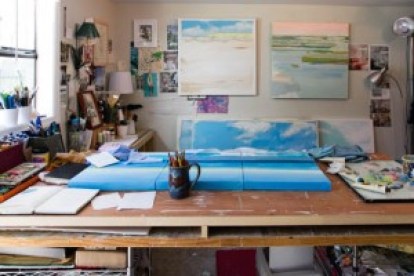
18 Artists Share Studio Tips

January 7, 2016 by Heather Filed Under: In the Studio, Inspiration & Education, Organize, Systems & Techniques, Tips & Resources 1 Comment

Going back through the past year’s 18 featured Artists I realized there are some amazing artist studio tips on organizing and productivity to be learned from these creative’s! If you missed one or more, here are the highlights. I am so grateful to get to meet these artists and be invited into their creative sanctuaries and I’m especially happy to be able to share them with you! From Maine to Charleston, New Zealand, to Switzerland it’s been an inspirational year interviewing these artists!

IMG_4182

Cobalt Sky:: I am always out of empty (yogurt) paint cups!! I just got wise and switched to cupcake liners! My pillows hang to dry, so my space is very product specific. I have exposed beams in the studio, without them I am not sure how I could manage. Last winter when we renovated the space- everything went OUT and only pillow business stuff came back. Now I feel organized! Doing this for my work space greatly improved the whole business.

Everything gets put away and the work table is clear after every work shift. In Maine we call that “ship shape”.

IMG_5085

Karl B::Most of my sewing supplies are attached to my work table or in the closets behind me. I keep my trusty shears in a holster on my belt. I learned which tools I needed to purchase or make and hung them from hooks on my worktable, the wall or made shelf space. For safety’s sake I always try to keep the the floor clean and first aid easily accessible.

IMG_1445

Ruth D::For the number of quilts that get ‘churned out’ each year, my stash of fabric is actually reasonable small, and easy to access and sort through. It’s all located in the black crates which we use all through our house. They are large, sturdy, and stack on top of each other if we need to. I thrive on systems, and am always reviewing to help me work more effectively. I keep a calendar on my iPad, always have several projects scheduled in there, broken down into manageable tasks.

On her “stash”…I actually enjoy the challenge of working with a limited range of techniques and materials.

On planning her studio…Desks and storage around the perimeter of the room, under the sloping ceilings made complete sense.

IMG_6462

Selinde L::I have always been one to finish things that I start before launching something new, preferring to work linearly. We do so much multitasking in our everyday lives now that I actually find this singular concentration therapeutic and even luxurious. That said, I usually have at least two journals and a sketchbook going at one time, places to store the myriad of ideas that pop into my head so that I can access them easily whenever I need to.

IMG_6270

Jennythreads::Growing up, I was naturally messy, and my dad remembers nicknaming me “Tornado Jenny” because my room was always such a mess. When I was in graduate school iI worked for an antique repair shop. This place was absolute chaos inside, my boss would take tools from my work area or leave his messes on my table and it started to drive me crazy. Fed up, I covered my table with white butcher paper and told him it was off-limits. From him, I finally learned how inefficient and exasperating it is to spend more time looking for tools or supplies than actually working, and that’s when I started making an effort to be more organized.I LOVE to purge things regularly. I keep a constant Goodwill bag in the garage as things get edited out of the house.  At the studio, I tend to keep more things around because they are useful. I keep some stashes, but I keep them under control.

IMG_6794

Finkelsteins::I consider myself an organized person even if my techniques for organization only make sense to me. My habits happen organically through necessity. Systems occur due either to space availability or the need to contain a certain type of material. I try keep like items together so I’m not running around in the middle of a creative process tracking down ribbon or thread. My productivity really drops if I’m pulled away to locate materials. A tip that works for me, I try to stick to buying only supplies that I absolutely need. I use to buy materials because it was fun to raid the craft store. As my space started to fill I stopped myself from doing that. I have slowly purged my storage bins of things that just take up space.

The Pixeladies::Deb doesn’t like to throw anything away. “We might need it.” Kris was born to purge. Since we work together every day we learn from each other. Both of our fathers were career Army/Air Force officers. That kind of discipline obviously rubbed off on us. We both remember having to “put things back where you found them.”MarlisEgger_little_helper

Marlis E::No one ever taught me to de-clutter, it came naturally to me, probably because I’ve always lived in small apartments. I like to live in a minimalistic zen-like space where everything has its place and where there is a lot of space to breathe. Most of us creative people have hoarding tendencies. We are so afraid we might need something “later” that we pile stuff around ourselves “just in case”. For example, if you love to work with paper, but don’t enjoy working with glue, why do you keep 10 different brands and qualities of glue? Keep only what you love and what you enjoy working with.

IMG_7983

Whitney K::I have always been a list-maker and have folders and books with everything written out. I have to have all my busy work finished in the morning- dealing with clients, commission emails, working with galleries, etc.- and then have a large block of consistent time to only concentrate on the actual painting. I do a big purge a few times a year. And I wouldn’t be able to live without a big old school calendar to see the month mapped out.

Multiple Pen & Pencil storage drawers-Alan's Home Studio Hirona M & Alan J:: On storage…Alan-Organizing large drawings with flat files and storing materials came from my experience in architecture school and architectural offices. I’ve learned other habits through trial and error and looking for products that solve specific storage problems. I’ve also had furniture built to help with storage challenges. Hirona-I am very compartment oriented, if not organized in a traditional sense.  I try to mark things, but sometimes materials are hard to categorize.  Things that reflect light could also be things that magnify or are metallic.  I’d say that I learned these methods from my parents.  Both have very specific ways of fitting and organizing things that make sense mostly to them.Compartments hold a variety of found objects

On schedules and systems…Alan-I have a Monthly Planner where I keep track of all appointments, deadlines and other significant dates. This is invaluable for keeping me on track and aware of what’s coming up. I also have a daily journal where I keep my daily To-Do lists and where I write down events of the day. Hirona-I don’t set a schedule for myself, I let the pressure of deadlines or genuine inspiration motivate me.  By rotating my focus from piece to piece and seeing everything together I can keep tabs on my progress and regulate the pace I’m working at.

Artist Morgan Santander's Studio

Morgan S::I like heavy items on wheels. My studio needs to be able to easily convert into a makeshift woodshop, a photo studio, a show space, a painting studio, and an office at any given time. If space is limited take advantage of vertical space and build the necessary storage accordingly. Building a large table on wheels, one that is specific to the studio space and my painting needs was important.

IMG_6327

Heather AH::I like to know where to find things so I have developed my own systems for organization. For 7 years I had a studio that had a mandatory sprinkler system that propelled me down a path of using clear plastic boxes to organize and store materials etc. It allows me to see where things are and allows me to easily carry things to another studio and they are already packed for moving! Everyone is different and so it is best to be aware of how you work and support your innate logic and way of working. Whenever I see a “system” at another artist studio or home, I use it for inspiration and modify it to fit me. My studios are constantly evolving to suit my needs.

IMG_0430
Beth MS::All of my surfaces re recycled. We collect them from our daily travels. My husband brings many things home from his treks to rural places. We don’t have much of an organizational system but we won’t give up trying

On her legacy…I feel like what I’m leaving behind is more than a piece of art work…..it’s the idea of making use of objects that others might discard.

IBU Inspration Wall

Jamie B-IBU::On inspiration…I’m surrounded by inspiration! We have a huge inspiration board that has great magazine photographs and clippings.

On knowing her limitations…usually work on up to three items at once. Any more and I might get un-organized in my thoughts and processes and be more prone to make a mistake.

IMG_1292

Craig C::On his art…Things change. Very simply I would say I make systems and these systems are constantly being updated. A few years ago I had a very romantic vision of being a full time artist; I would sip tea and think in a bright colored robe. In reality I’ve never done that. I don’t even have a robe. I spend most of my time  promoting what I’m doing and\or chasing new opportunities. Which is certainly not a bad life. I have always thought art could expand beyond the work.

When I was younger I had a great memory. I could remember whole tour itineraries not anymore. I save everything I can now mostly so I can show my daughter someday. But I’m also leaving myself a breadcrumb trail. I meet so many amazing people in my travels I hope to document them all.

On Sound + Light…I’m coming at this from a touring musician’s start, I deliver and install everything myself. I have created a life that allows me to pack the van and hit the road. I am very proud of the pack. I like the idea of space and how we can manipulate it.

painting siupplies

Rob M::My paints are all in a central location, stored in my taboret. I don’t line my colors up in a row or organize my brushes but they’re all right there ready to go when I want them. I must admit I keep a lot of material that were passed down from my father, which I never use. I keep them around because they inspire me.

On staying motivated…the constraints in my mind sometimes say “why bother?” It’s then I remind myself, I’m painting for the ages and not just a quick sale in a gallery.

Karin Olah's studio

Karin O::Pencils, scissors, paint brushes are bouquets of art supplies in flower pots. I use my cool Lobo easel that can fold down to a table top for the fabric layer process. I have an L-shaped desk made of luan blank doors, sandwiched with a space that works as a flat file for paper, unfinished art, a wet palette, or anything to keep clear of my toddlers’ adorable fingerprints.

On time management…When I have a show or project coming up, I work 40 hours a week – 10 of which is in front of a computer, doing marketing, inventory, emails, and website stuff.

On planning…

  • I buy the frames for a show before I make the art.
  • I know my car measurements and space limitations.
  • I create a worksheet of blank canvas inventory and fill it in as I go.

IMG_1393Duke H::I am disciplined. The Creative process is work, nothing comes easily. I sit down and just do this (doodle and sketch). Never wait for inspiration to come to you. Just sit down and do it (that does take discipline!). I treat my art as a business, I keep files of expenses etc just to keep things efficient.

When it comes to archiving…A fellow painter died several years ago without archiving, it was a real mess. I have been serious about this for the past three years.

What have you learned or loved from the Inside the Artist Studio feature? Is there anything you would like me to ask or share from artists I interview in the future? Any artists you would like to see featured? Leave me a comment or shoot me an email, I’d love to hear your ideas!

Makeover Monday::Playful Organizing

December 28, 2015 by Heather Filed Under: Art & Design, Home, Organize, Organizing Projects, Systems & Techniques 1 Comment

This year I had the pleasure of working with a family household (parents, 2 kids under 5 and a dog:) who wanted more general order all around. They were not in a horrible situation, just looking to improve upon organizing systems and create some where none existed. With busy families I often find that things fall apart because there are only partial systems in place or none.

Playful Organizing

This house has a great family room, open to the kitchen which allowed for family time and meal prep to all be in one space. With two little boys though, the play area got messy quickly and mom and dad’s kitchen space was often overtaken by toys and their own daily “landing pad” stuff (mail, purse, laptop, kids art etc). We decided upon our first session the kids play area would be priority number one with the kitchen to follow. Following the SPACE system (created by Organizer and Author Julie Morgenstern) we Sorted, Purged, Assigned, Containerized and Equalized the kids play area.

Kids Play Area-Before

No Slide Found In Slider.

The kids play area off the kitchen had ample storage for a reasonable amount of toys in this space but it was awkward, narrow, hard to reach, overflowing and partially unusable. Our first step was to modify the cabinets (done by a professional) by changing the configuration and height of shelves, installing additional shelves and removing the door from the area under the stairs to create a “garage” for the boys cars and trucks. With the toys purged and sorted and the cabinet modifications in place we measured and ordered specific containers based on the types of toys needing to be stored in the space. These included clear “shoe boxes” for smaller toys, an alligator bin for larger toys under the stairs, translucent totes for inside cabinet shelves and oval ‘chalkboard’ labels for everything. Books and musical instruments were moved to additional cabinets nearby but separate from the rest of the toys.

Kids Play Area-After

No Slide Found In Slider.

This whole project could have been done with existing storage containers but because this area is so widely used by both the family and for entertaining, it made sense to invest in specific storage containers and create a system that was easy to use, clean up and maintain. The finished space is beautiful, functional and FUN!  In the new year, during GO-Month (Get Organized-January!) I’ll be sharing the kitchen makeover from this home.

In the Studio with Craig Colorusso-Part II

November 25, 2015 by Heather Filed Under: Art, Art & Design, In the Studio, Inspiration & Education, Organize, Photography

How did artist Craig Colorusso fit an 80,000 Square Foot Installation into a mini-van? We met while I was a docent during the recent installation in Charleston of Sound + Light and Craig not only agreed to do this interview (see Part I last week with  photo’s of his studio in Arkansas) but suggested it might be interesting to watch him dismantle and meticulously deconstruct and pack out the entire massive 4 part installation into his van. This week I’m excited to share his installation pack out and some specific questions related to his process!

Inside the Studio with Craig Colorusso- Sneak Peek Part II

From this…

Cube music::Charleston SC Warehouse

HKPS:: How much thought do you give to your artistic body of work in terms of historic value and the overall legacy you will leave behind? How do you store/archive your work or records?
CC::I now save everything. When I was younger I had a great memory. I could remember whole tour itineraries not anymore. I save everything I can now mostly so I can show my daughter someday. But I’m also leaving myself a breadcrumb trail. I meet so many amazing people in my travels I hope to document them all.

The next few questions are specific to Craig’s installation, planning and transportation of art.

HKPS::How long have you been creating art for installations and do you always deliver and install your own works?

CC::In 1996 I did a show called Maschine. Joel Westerdale, drummer of China Pig and I worked at a print shop in Danbury CT. Somehow we convinced our boss to let us do a show in the shop. So, we woke up at 4am a few times to practice before anyone arrived at work. It was great to start that early. Looking back I always enjoyed being awake doing things when it seemed like everyone else was asleep. And I like warehouses. Anyway, we composed a piece of music for instruments and two offset presses. 2 AB Dick 360’s. We brought in Guitar, Bass Clarinet, Timpani, Drums and Saxophone to pay with the roar of the presses. The shop was such an integral part of the piece it got me thinking about space. And other elements beside just music. Since we worked there we were able to do a lot with light as well. The wheels are still turning…
Since I’m coming at this from a touring musician’s start I deliver and install everything myself. I have created a life that allows me to pack the van and hit the road. I always so this life as making something and sharing it. Part of the sharing is me. I got the tour bug early on and still like it. When I was 19 my good friend Todd Ransick called me up and told me the guitar player in his band Far Cry didn’t wanna go on tour because he was afraid his girlfriend would cheat on him. So I made way to Bethesda Maryland and practiced for a few weeks and left on my first tour. It was even better than I thought it would be. So here we are all these years later.

HKPS::How did you plan for the packing and transportation of your installation work?

CC::I suppose I always have the van in mind. And sometimes I rely on my packing skills a little too much but it works.

Craig Colorusso-Pack Out

No Slide Found In Slider.

HKPS::Was Sound + Light the first show you have done with all 3 installation components?

CC::This was the first time I was able to present all 4 pieces and the film.

HKPS::Did you plan any of your artwork around the logistics of transportation or keep the transport in mind when designing your works and their modular components?

CC::I have a few platforms that I’ve built for CUBEMUSIC and Sun Boxes to fit nicely in the van. MB 89 has toured by itself so I thought it would all fit. But honestly there were a few moments that I thought I would have to get another vehicle.

HKPS:: Did you have an idea of how to pack your van or did you have to try things out till you were able to make it all fit?

CC::The pack that went to Charleston was revised 3 times before it all worked. I am very proud of the pack. I like the idea of space and how we can manipulate it.

To this…(in approx 4 hrs)

Van Packed with Art Installation

Thank you Craig for sharing how you work, your planning and process! I loved being a part of the Sound+ Light experience and watching the show come down and be packed into that small space, Bravo!  You win the “Puzzle” award for fitting  80,000 square feet of art installation into one little van!

*The idea for the Inside the Artist Studio series began while attending an art retreat where I curiously observed the differences in the creative cycle of order and chaos and what that looks like for different individuals. I’m very interested in sharing how organizing affects the artist’s creative process.  Some systems and order are vital to our creative PLAY and learning to find a balance that works to enhance your creativity is what I hope to share with you through these interviews.

———————————————————————————————–

Is there a particular artist whose ‘Tool kit’  or studio you would like to see featured? Please leave a comment below and let me know!

Save

  • « Previous Page
  • 1
  • …
  • 21
  • 22
  • 23
  • 24
  • 25
  • …
  • 38
  • Next Page »

info@hkpowerstudio.com
[office] 240-778-2804 *area code must be dialed/no text

Legal Disclaimer

Creatively Organized Spaces by HKpowerStudio Inc. is not qualified to give legal, tax, accounting, financial, medical, or therapeutic advice, and any services, content or products are solely provided for informational purposes only.

Search Blog by Popular Catetories

Seach Blog by date

Copyright © 2026 · Swank WordPress Theme By, PDCD